
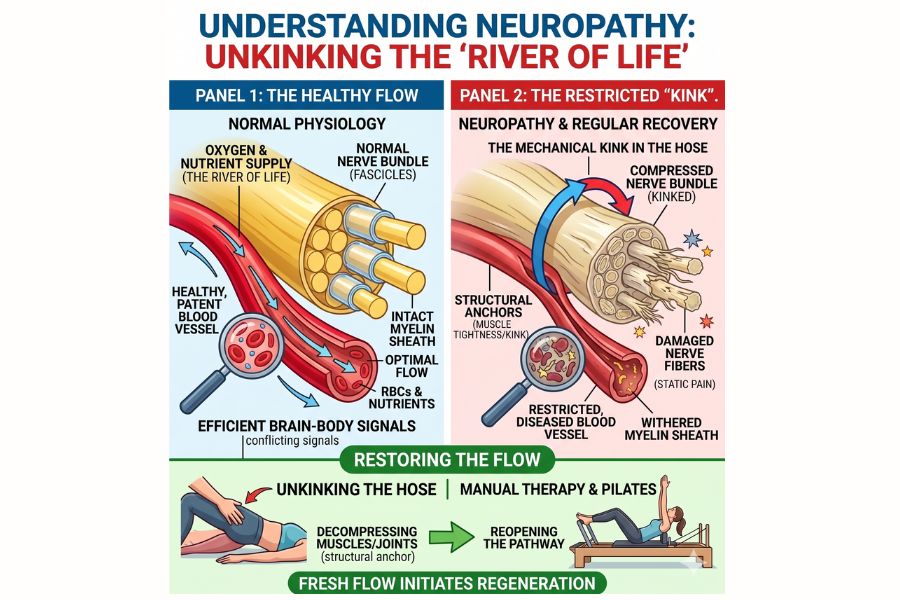
If you have ever felt a sudden, electric “zinger” down your leg, or a persistent numbness in your feet while hiking the Austin trails, you are looking at the exact biological process shown in this image.
Many people view nerves as simple, isolated electrical wires. But structurally, a nerve is far more complex—and its health is entirely dependent on your circulatory system. When that connection is interrupted, it creates a systemic “kink in the hose” that leads directly to neuropathy.
The Anatomy of a Nerve Band
Think of a major nerve like a massive fiber-optic cable running through your body. As the top half of the diagram shows, a healthy nerve is actually a tightly packed bundle of smaller nerve fibers fascicles.
Running right alongside this bundle, wrapping around it like a protective vine, is a healthy blood vessel. This vessel is responsible for delivering a constant supply of oxygen and essential nutrients to the nerve tissue. This is the River of Life in action. When blood flow is optimal, the nerve fibers can transmit signals smoothly between your brain and your limbs without any “static.”
What Happens When a Nerve is Damaged?
The bottom half of the image illustrates the cascading failure that happens during neuropathy. It almost always begins with the blood vessel, not the nerve itself.
When a blood vessel becomes diseased, compressed, or restricted due to chronic muscle tightness—such as a locked-up psoas or tight hip stabilizers—the diameter of that vessel shrinks. The flow of oxygenated blood slows to a crawl.
Deprived of oxygen, the nerve enters a state of distress. The protective myelin sheath surrounding the nerve fibers begins to wither and degrade, leaving the nerve fibers frayed and damaged. Instead of clean, efficient communication, the damaged nerve begins to misfire, sending chaotic signals to the brain. This is the exact root cause of the burning, tingling, and sharp shooting pains associated with neuropathy.
Restoring the Flow to Regenerate the Nerve
The good news is that peripheral nerves have an incredible capacity to heal—but only if you restore their lifeline. You cannot heal a damaged nerve without first fixing the diseased blood vessel supplying it.
To reverse this cycle, we must remove the mechanical pressure trapping those blood vessels. By using targeted physical therapy to decompress the joints and utilizing the structural movement of Pilates to stabilize the pelvis, we physically unkink the surrounding tissue. This reopens the pathways, allowing fresh, nutrient-rich blood flow to surge back into the nerve band, kickstarting the natural regeneration process and quieting the nervous system for good.
Are you ready to stop managing the symptoms of neuropathy and start restoring your body’s natural flow? [Schedule Your Discovery Visit in West Lake Hills Today]